Fox Cupid: A Playful Color Fonts Choice for Local Branding
As a brand designer who’s developed visual identities for over 30 local businesses—from artisanal candle studios in Portland to family-run bakeries in Austin—I approached Fox Cupid not as another decorative font, but as a potential graphic design asset for real-world packaging, labels, and customer-facing marketing visuals. My first impression? It’s instantly warm, approachable, and emotionally resonant—like a handwritten note tucked into a handmade soap box or stamped on a seasonal coffee bag.
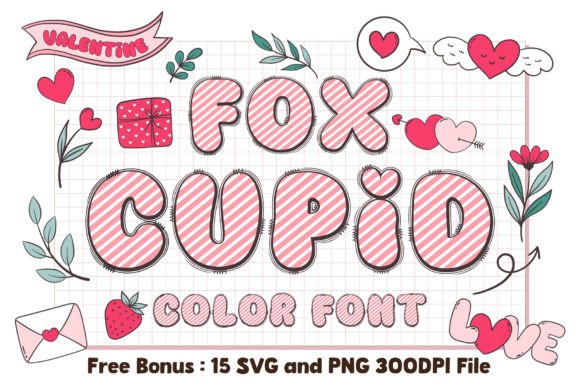
Fox Cupid leans into soft playfulness without tipping into childishness. Its rounded forms, gentle curves, and built-in color layering suggest warmth, affection, and handcrafted care—ideal for small business branding where authenticity and emotional connection matter more than corporate polish. It reads as feminine but not fragile, festive but not fleeting, and modern but not sterile. Think: a lavender-scented skincare line launching a “Spring Crush” limited edition, or a neighborhood florist designing Mother’s Day thank-you cards that double as social media graphics.
In practice, Fox Cupid shines where personality meets practicality. For product label design, it works beautifully as a secondary headline—pairing with a clean sans serif for ingredients or origin statements. On bakery packaging, it elevates cupcake boxes and cookie tags with just enough charm to stand out on a crowded farmers’ market table. As part of a boutique’s brand identity, it adds consistent whimsy to hang tags, receipt stickers, and window decals—reinforcing visual hierarchy without sacrificing legibility at 24–36pt sizes.
It strengthens local business presentation in tangible ways: a stronger first impression on shelf or screen, clearer distinction from competitors using generic fonts, improved customer trust through intentional, human-scaled design, and more polished marketing visuals across print and digital touchpoints. When used thoughtfully, Fox Cupid helps handmade businesses signal care—not just in their products, but in how they present them.
Where does Fox Cupid deliver the most value? In hero graphics for seasonal campaigns (think Valentine’s Day chocolates or summer solstice tea blends), decorative brand elements like border accents on printable inserts or packaging flaps, product mockups for Etsy listings, social media campaign graphics (especially Instagram carousels and Reels thumbnails), and boutique visuals like in-store signage or loyalty card designs. It also excels on thank-you cards, sticker sheets, and limited-edition packaging—places where emotional resonance directly supports retention and word-of-mouth.
But—and this is critical—it’s not a universal solution. Avoid using Fox Cupid for formal corporate branding, legal disclaimers, ingredient-heavy food labels, or any area requiring strict readability at small sizes (under 14pt). It competes poorly against dense backgrounds or low-contrast color schemes, and its decorative nature clashes with luxury minimalist brands that rely on restraint and negative space. If your local business positions itself as ultra-premium—say, a small-batch olive oil line with matte black glass bottles—Fox Cupid may dilute perceived value rather than enhance it.
Before committing to Fox Cupid in your next packaging design or brand rollout, here are the practical checks I run as a working brand designer:
- Test it on real packaging mockups—not just screen previews—to assess how color layers hold up in CMYK print or foil stamping
- Check black-and-white usage: Does the glyph structure remain legible when color is removed? (Crucial for accessibility and monochrome printing)
- Preview it on actual small labels—especially curved surfaces like jam jars or candle tins—to verify spacing and kerning integrity
- Test it alongside your full brand palette: Does the built-in coloring harmonize with your primary and accent colors, or fight them?
- Compare it side-by-side with competitor packaging on shelf or online—does it help your product stand out, or blend in?
- Review PNG transparency and SVG vector editability: Can you isolate glyphs for custom layouts? Are stroke weights consistent across characters?
- Test pairings: How does Fox Cupid sit beside a strong serif (for authority), a neutral sans (for balance), or a delicate script (for layered texture)?
- Confirm commercial licensing covers physical product sales, digital distribution, and client work—many Color Fonts lack extended rights for resale-based businesses
Fox Cupid isn’t just another download from a creative marketplace—it’s a strategic tool for small business owners who understand that packaging design, social media graphics, and even a simple thank-you card are all extensions of brand identity. When aligned with thoughtful logo design, cohesive color systems, and audience-aware messaging, it becomes part of a larger system of professional branding—not decoration for decoration’s sake.
For local business owners, handmade sellers, and creative entrepreneurs building real brands—not just assets—Fox Cupid offers something rare: expressive warmth that translates across mediums. Used with intention, it supports stronger product recognition, better shelf appeal, and more emotionally grounded marketing visuals. Just remember: every graphic design asset earns its place in your toolkit by solving a real problem—not by looking cute in isolation.
If you’re developing packaging design for a new line of herbal teas, refreshing the label system for a craft kombucha brand, or launching a printable design collection for fellow makers, Fox Cupid deserves a seat at the table—provided it’s evaluated not as a novelty, but as a functional element of your small business branding ecosystem.